October 30, 2026
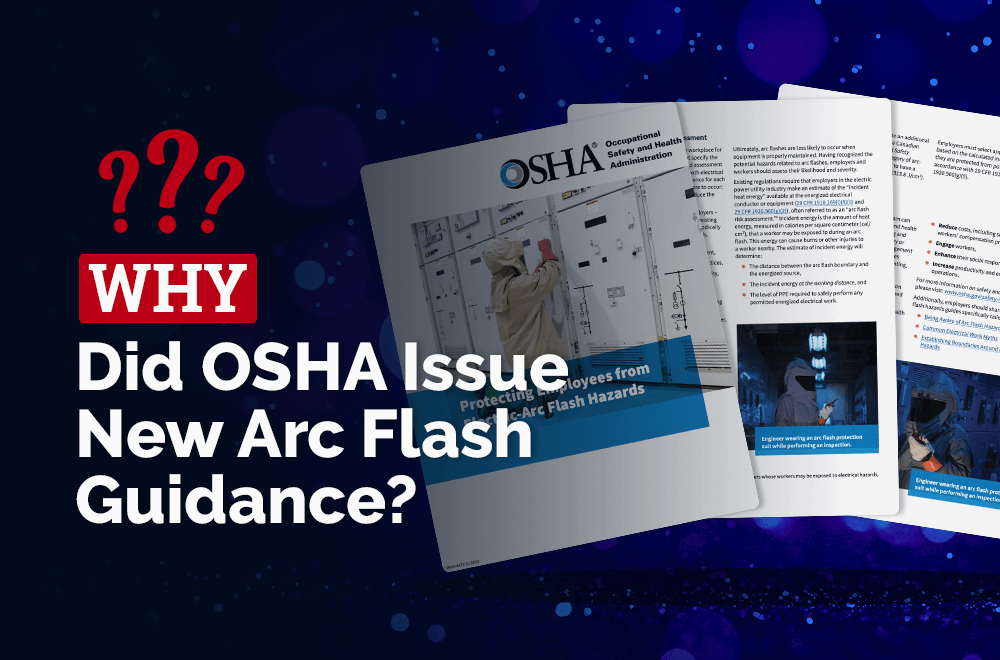
Why Did OSHA Issue New Arc Flash Guidance?
February 28, 2025
In November 2024, the Occupational Safety and Health Administration (OSHA) issued new arc flash guidance for the first time in over 20 years. This updated guidance was published in response to stalled progress in reducing electrical injuries, persistent misconceptions about low-voltage work, and gaps in PPE compliance that continue to put workers at risk.
The updated guidance re-emphasizes existing safety requirements, addresses ongoing compliance gaps, and refocuses attention on protecting workers exposed to energized electrical hazards.
Watch: Scott Margolin (VP of Technical) explains what triggered the new guidance, and why OSHA took action in 2024.
Ongoing Safety Issues in Electrical Work
Despite decades of progress, electrical injuries and fatalities have plateaued. OSHA identified persistent jobsite-level issues that continue to expose workers to arc flash hazards:
- Arc flash Incidents Remain Common
Workers continue to suffer serious injuries because arc flash events still occur during both low- and high-voltage electrical tasks. These incidents are often tied to routine work performed under energized conditions. - Widespread Misconceptions About Electrical Safety Persist
Many employers and workers underestimate the risks associated with energized work—particularly at lower voltages. Common misunderstandings include the belief that low-voltage systems are inherently safe or that certain tasks do not require energized work permits or full protective measures.
The guidance reinforces the critical message: never work energized without a valid energized work permit and appropriate arc rated PPE.
Key Reasons OSHA Updated Its Arc Flash Safety Guidance
OSHA updated its arc flash guidance to address systemic gaps that existing standards alone were not closing:
- Arc Flash Risks Remain Unacceptably High Across Industries
While injury rates declined significantly following the introduction of standards such as NFPA 70E, OSHA determined that many arc flash incidents remain preventable and continue to occur in a wide range of electrical work environments. - Inconsistent Application of Arc-Rated PPE Requirements
OSHA observed that arc-rated and flame-resistant (AR/FR) clothing and PPE are not consistently selected, maintained, or worn when hazard assessments indicate they are required. The updated guidance emphasizes:- Proper selection and care of AR/FR protective equipment
- Training workers to recognize when arc-rated PPE is necessary
- Aligning PPE use with current hazard analyses and job planning
- Need for Clearer Alignment With NFPA 70E and Industry Best Practices
OSHA’s guidance builds on NFPA 70E, the leading safety standard for electrical work practices in the US, offering more actionable direction for employers and employees in real-world settings. In doing so, OSHA reinforces core electrical safety principles like:- Don’t work energized if you don’t have to.
- De-energized is NOT the same as properly locked out and electrically safe (LOTO/ESWC).
- Low voltage does NOT mean low risk.
- Non-rated-rated clothing increases injury severity during arc flash events
What OSHA’s New Arc Flash Guidance Means for Electrical Workers
If OSHA had not stepped in with updated arc flash guidance, the risk to electrical workers would only continue to grow. Demand for electrical work is accelerating due to several industry trends accelerating the volume and complexity of electrical work:
- Government investments in power grid upgrades and EV infrastructure
- NFPA 70B’s new status as a standard mandating electrical gear maintenance
- Retiring “Boomer” electricians and an influx of rookies
How the Updated Guidance Directly Impacts Electrical Workers
- Improved Hazard Awareness at All Voltage Levels
The guidance reinforces that arc flash hazards exist in both low- and high-voltage systems, correcting long-standing misconceptions that have led workers to underestimate risk. - Clearer Rules Around Energized Work
Electrical workers should expect stricter expectations for when energized work is permitted, including formal justification, documentation, and approval through energized work permits. - More Consistent Use of Arc-Rated PPE
The guidance emphasizes proper selection, maintenance, and use of arc-rated PPE based on current hazard assessments—reducing the severity of burn injuries when incidents occur. - Expanded Training and Competency Expectations
Workers will see increased emphasis on training that improves hazard recognition, PPE decision-making, and safe work practices in real-world conditions. - A Stronger Culture of Electrical Safety
By reinforcing proven principles such as de-energizing equipment whenever possible, the guidance supports a shift toward safer planning, better communication, and shared responsibility on the jobsite.
The Bottom Line: More workers are entering high-hazard electrical environments, while new standards and infrastructure investments are increasing both the amount and complexity of energized work. Issuing clearer guidance, specifically targeting the myths around low voltage and de-energized work, increases awareness for the importance of arc-rated clothing and PPE and drives down arc flash fatalities and injuries.
Ready to take action?
Learn how OSHA’s updated guidance impacts your electrical safety program—and what to do next:
- Watch our on-demand webinar
- Explore our resource hub
- Brush up on the fundamentals of the arc flash hazard
Need further assistance? Contact us today.