




October 6, 2026
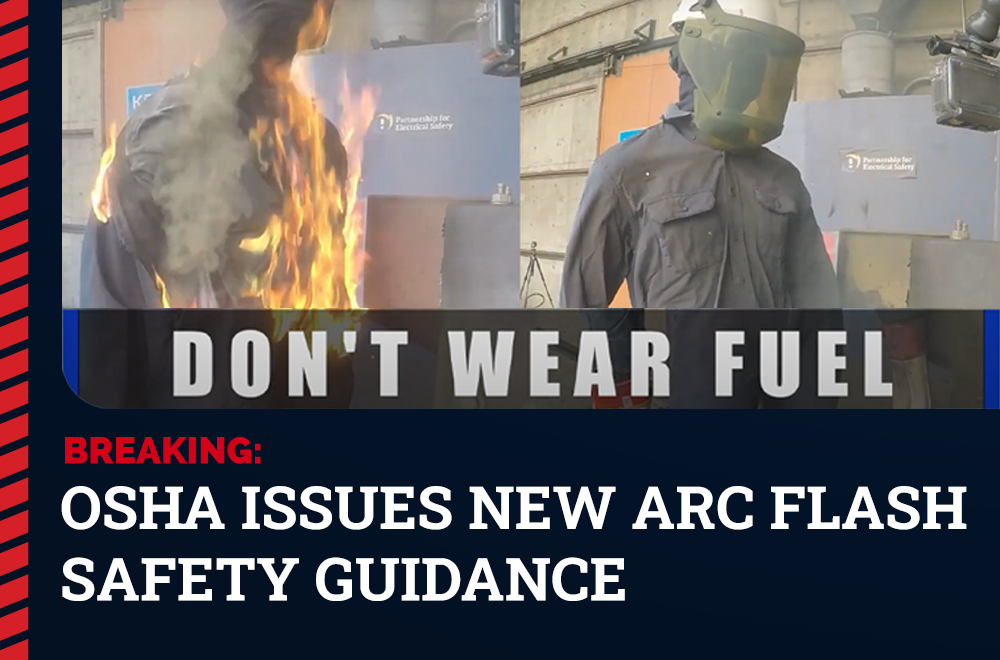
BREAKING: OSHA ISSUES NEW ARC FLASH SAFETY GUIDANCE
November 25, 2024
Breaking news: OSHA has just released new guidance on arc flash safety – for the first time in almost 20 years. Recognizing the continued prevalence of preventable arc flash injuries and fatalities despite longstanding safety standards and proven PPE the guidance is designed to better protect commercial, industrial, and residential electricians from arc flash hazards. It consists of four parts, including a detailed document for employers and three one-page documents for workers. The guidance focuses on several important topic areas, with the central theme targeting the underutilization of appropriate lifesaving arc-rated (AR) clothing and personal protective equipment (PPE).
Scott Margolin, Vice President of Technical, shares the latest:
What you need to know:
What does the new guidance say?
The new guidance was primarily issued to address the two leading causes of arc flash injuries and fatalities in the USA today:
- De-energized is not the same as LOTO / ESWC and as such requires an energized work permit and arc-rated PPE. It’s vitally important to understand what’s truly de-energized work, and the truth is the significant majority of tasks which claim to be de-energized do not qualify as such under OSHA (Lockout/Tagout) and NFPA 70E (Electrically Safe Work Condition) – requiring PPE. Not wearing PPE while working on equipment believed to be de-energized is the #2 leading cause of arc flash injury and fatality in the US today.
- Choosing to work energized because “it’s only low voltage” (120/208, 277, etc.) despite lack of justification, and not wearing PPE because of the common and dangerous myth that low voltage isn’t hazardous. Energized work typically requires an energized work permit and appropriate PPE where indicated by table 130.5(C) in NFPA 70E or an incident energy study indicating an arc hazard of 1.2+ cals. Tyndale’s own Jason Brozen is living proof that the idea low voltage can’t arc at all or won’t sustain an arc in air is a dangerous one. Jason nearly lost his life in an arc that occurred at 120/208 voltage, and OSHA’s new guidance recognizes the severity of this hazard.
Who does the guidance apply to?
The new OSHA arc flash guidance applies to all commercial, industrial, and residential electrical workers in the USA, and to operators, maintenance and other personnel who work on or near exposed energized electrical parts.
Where can the guidance be found?
The guidance was issued as a longform document for employers and a series of three “quick cards” – one-page documents designed to be easily digested and referenced at-a-glance – for workers in the field. The guidance can be accessed on OSHA’s website (here).
Additional information can be found on Partnership for Electrical Safety’s (PES) website and Tyndale’s resource hub.
When was it issued, and when does it take effect?
OSHA announced the guidance was forthcoming in September 2024, and formally released the guidance in November 2024. The guidance is in immediate effect. Employers and electricians should take swift action to close protective gaps and comply.
Why now?
OSHA has issued this guidance after several years of working with the Partnership for Electrical Safety (PES) and the US House and Senate because injuries and fatalities continue to occur among commercial and industrial electricians at an alarming rate – despite the existence of proven protective equipment and longstanding safety standards mandating that protection.
NFPA 70E incorporated arc flash safety in the year 2000, and over the subsequent 10 years arc flash injuries and fatalities went down at the same rate as compliance with NFPA 70E and use of AR clothing went up. However, the injury rate leveled off after 2010 and continues to occur at about half the pre-2000 rate because hundreds of thousands of electricians continue to work energized without the work permits and PPE necessary to ensure safe work and good outcomes should an incident occur.
And now, unprotected workers may face increasing exposure to arc flash hazards as a result of:
- Government investments in advancing transportation and infrastructure projects like enhancing the power grid and installing electrical vehicle charging stations.
- Elevation of electrical maintenance standard NFPA 70B from a recommended practice to a proscriptive standard – necessitating a “catch up” period as electricians work to bring poorly-maintained gear in line with the standard.
How do you get started?
Tyndale is here to support employers in analyzing and complying with OSHA’s direction – protecting workers with proven, comfortable arc-rated clothing and service solutions that make compliance easy for companies of any size.
You can also request a complimentary technical consultation with our lead trainer Jason Brozen – master electrician, CESCP (NFPA 70E trainer), and arc flash survivor – who is available to assist with understanding hazards and training.
Whether you’re familiar with the arc flash hazard, NFPA 70E, and AR PPE or just getting started, bookmark TyndaleUSA.com/blog and check back regularly as we dig into the new guidance and share all you need to know to better protect workers. Together we can change the statistics around arc flash injury and fatality.
Have a question in the meantime? Schedule a complimentary technical consultation or contact us at MarketingInfo@TyndaleUSA.com.