October 6, 2026
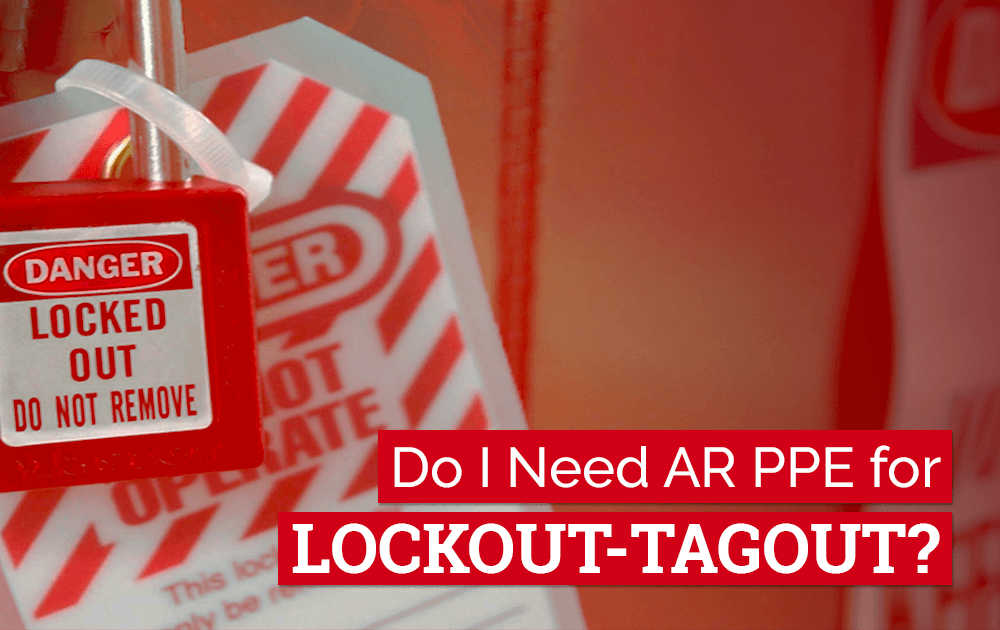
The Truth About Lockout/Tagout and Arc-Flash PPE
April 4, 2025
Working on or around electrical hazards almost always requires personal protective equipment (PPE)—even in situations you might not expect. As part of our Do I Need AR PPE for That? series, we explore this common scenario in electrical work and whether arc-rated clothing is needed for safety and compliance.
What Safety Standards Require for Lockout/Tagout and Arc Flash PPE
OSHA’s arc-flash guidance (released November 2024) addresses a common question: Do you need arc-rated clothing during lockout/tagout (LOTO) to achieve an electrically safe work condition (ESWC)?
Yes. In most cases, arc-rated (AR) clothing is required during the LOTO process because arc flash hazards remain until an ESWC is fully verified.
While performing electrical tasks, LOTO procedures and arc flash PPE are not optional. Too often, electricians and technicians misunderstand when PPE is required—leading to preventable burns, injuries, and OSHA violations. It’s easy to assume that LOTO is de-energized work—but in the vast majority of cases it isn’t. Every step of the LOTO process must be complete before it meets OSHA’s standard for an electrically safe work condition.
Watch: Scott Margolin (VP of Technical) explains why LOTO is considered energized work and the importance of arc-rated PPE during this process.
What Is Lockout/Tagout (LOTO)?
LOTO is an OSHA-mandated safety procedure used to control hazardous energy during the servicing and maintenance of electrical equipment and machinery. Its purpose is to ensure equipment cannot be started, energized, or release stored energy while work is being performed. Under OSHA and NFPA 70E, the LOTO procedure is not considered de-energized work until all eight steps for establishing an ESWC have been completed and verified.
What Is an Electrically Safe Work Condition (ESWC)?
According to Article 100 of NFPA 70E, an electrically safe work condition is defined as:
“A state in which an electrical conductor or circuit part has been disconnected from energized parts, locked/tagged in accordance with established standards, tested to ensure the absence of voltage, and grounded if determined necessary.”
That means the LOTO process itself is still energized work—and all workers must wear appropriate AR clothing throughout the process.
To meet OSHA’s Control of Hazardous Energy (Lockout/Tagout) standard and the requirements in NFPA 70E, these eight critical steps must be followed before a task is considered electrically safe:
8 Steps to Establish an Electrically Safe Work Condition
- Identify all potential sources of electrical supply to the specific equipment. Check applicable up-to-date drawings, diagrams, and identification tags.
- Interrupt the load current and open the disconnecting device(s) for each source.
- Visually verify that all of the blades of the disconnecting devices are fully open or that the drawout-type circuit breakers are withdrawn to the test or fully disconnected position.
- Release stored electrical energy within the system.
- Block or relieve stored nonelectrical energy in devices to the extent the circuit parts cannot be unintentionally energized by such devices.
- Apply lockout/tagout devices in accordance with a documented and established procedure.
- Test all phase conductors or circuit parts at each point of work using a properly rated instrument. Always test both phase-to-phase and phase-to-ground to confirm the absence of voltage.
- Where the possibility of induced voltages or stored electrical energy exists, ground all circuit conductors and circuit parts before touching them. Apply temporary protective grounding equipment, if necessary, per NFPA 70E 120.6(8).
Until every one of these requirements is met, the work is still considered energized, and electrical hazards—including arc flash—remain present.
Why LOTO Is Still Considered Energized Work Under OSHA and NFPA 70E
Many workers assume that once a breaker is switched off and locked, the equipment is de-energized. This misunderstanding is widespread—and dangerous. In reality, OSHA and NFPA 70E classify LOTO as energized work because it occurs before an ESWC is established.
Key Facts about LOTO Safety Requirements and Procedures
- In 2024, lockout/tagout ranked fifth on OSHA’s list of most frequently cited safety violations, with 2,443 citations, only slightly down from 2,554 violations in 2023.
- OSHA estimates that compliance with the lockout/tagout standard prevents 120 fatalities and 50,000 injuries each year.
- Tasks such as opening disconnects and visually verifying blade position, releasing stored electrical energy, applying locks, and performing voltage testing all take place while the system’s energized status has not yet been eliminated
Because the electrically safe work condition has not been established, OSHA and NFPA 70E treat the LOTO process itself as energized work. This classification—not worker intent or perceived risk—is why electrical hazards, including arc flash, must be assumed present until verification is complete.
Choosing the Right Arc Flash PPE
While regulations define LOTO as energized work until verification, PPE requirements are driven by task-based exposure during the process. NFPA 70E identifies activities such as opening the equipment’s disconnecting means, applying lockout devices, and performing voltage testing as tasks with potential arc-flash and shock exposure.
Each of these steps places the worker in proximity to electrical conductors or circuit parts that may still be energized due to back feed, stored energy, incorrect labeling, or equipment failure. Arc-rated clothing and electrical PPE are required not because maintenance has begun, but because the worker is actively interacting with equipment before its energized state has been eliminated.
Arc-rated shirts and pants or coveralls, voltage-rated gloves, and appropriate head and face protection must be worn until testing confirms the absence of voltage and the electrically safe work condition is established. Treating PPE as optional during LOTO—or delaying its use until troubleshooting or repair—introduces unnecessary risk during one of the most error-prone phases of electrical work.
Key Takeaway for Electrical Workers and Safety Managers
- Lockout/tagout is not de-energized work by default.
- Until all NFPA 70E steps are completed and absence of voltage is verified, LOTO is energized work.
- In most cases, AR clothing is mandatory for LOTO
Tyndale’s Position:
Daily wear arc-rated clothing that exceeds the hazard’s estimated incident energy level provides consistent protection during LOTO tasks, reduces PPE decision errors, and helps organizations stay compliant with OSHA and NFPA 70E requirements.
Compliance with LOTO saves lives—but only when it includes appropriate PPE. OSHA’s new guidance is clear: don’t wear fuel! Choose AR PPE that keeps you or your team protected during every stage of the job.
Need gear? Browse hundreds of AR product options to meet every need.
Do I Need AR PPE for That?
Don’t ever go without the proper arc-flash personal protective equipment (PPE) again! This series dives into some of the most common situations in which AR PPE is needed and why. Access all posts in this series to learn more about these situations and how you can best stay protected while working in electrical environments.