





October 6, 2026

Arc Week Season 6, Ep. 3 – Belief: “We Don’t Work Energized.”
August 20, 2025
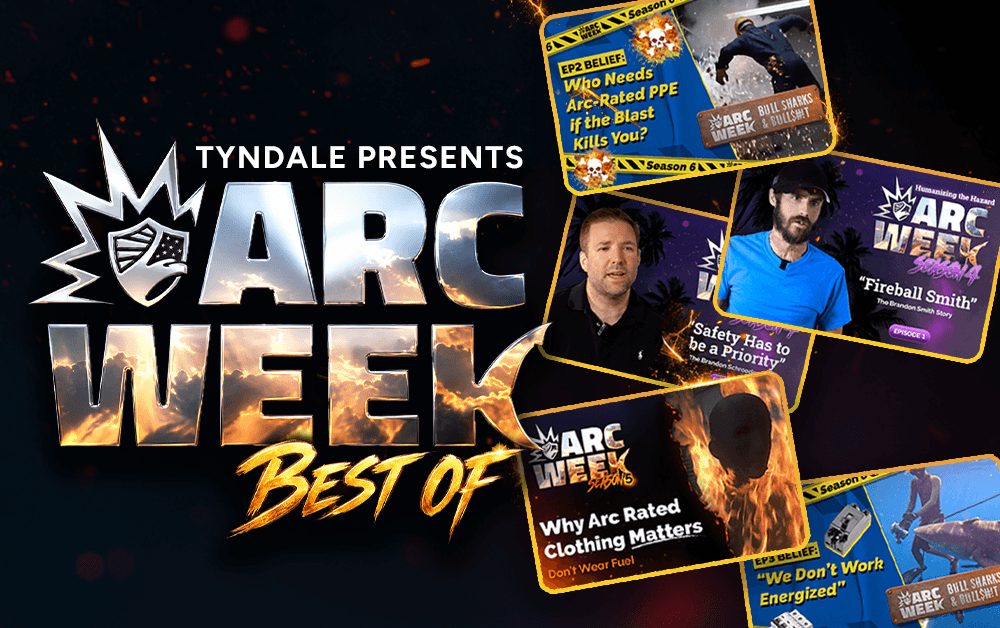
Tyndale presents Arc Week: a unique, week-long educational look at the world of arc flash hazards through the lens of Shark Week. Join Scott Margolin – our dedicated technical expert by day and passionate shark enthusiast in his free time – for engaging, memorable parallels that bring important lessons about risk protection and PPE to life. Catch it all: Season 1, Season 2, Season 3, Season 4, Season 5, Season 6.
Think you’re safe to skip arc-rated (AR) PPE because the power is off? Think again. Before you trust the hearsay, watch this — it could be the difference between walking away and a life-changing injury (or worse!).
Why OSHA Says You’re Working Energized — Even If You Think You’re Not
Some in the field believe: “I’m not working energized — so I don’t need arc-rated PPE.”
OSHA couldn’t disagree more. In fact, OSHA recently issued brand-new arc flash guidance aimed at this very mindset, naming it as the leading cause of arc flash injuries and fatalities today. And this isn’t a new problem — the standards have addressed it for over two decades. Yet it remains one of the top causes of injury and death in electrical work today.
OSHA's Take:
- No Incident Energy Study? If your company hasn’t completed a formal incident energy analysis for your specific equipment (and most haven’t), you must use the category or tables method in NFPA 70E to determine your PPE.
- What NFPA 70E Says: The table method requires Category 1 arc-rated PPE at minimum — even if you believe the equipment is “off.” Need a deeper dive into NFPA 70E? Check out our step-by-step series, NFPA 70E Made Easy.
- The Electrically Safe Work Condition (ESWC) Reality: You’re not truly de-energized until you’ve completed all 8 steps of the ESWC process, including the live-dead-live test. That step requires exposure to energized parts — meaning you are working energized until testing confirms otherwise.
What the Experts Say
David Wallis — subject matter expert and architect of OSHA’s original electrical safety standards — puts it plainly:
“It’s not de-energized until it’s locked out, tagged out, and tested. Equipment must still be considered energized until you open the circuit and test where you’re going to touch.”
“That’s key,” he says, because circuits can remain energized for more reasons than you’d expect — and assuming otherwise can be fatal.
Legit or bull$#!t? This belief is 100% BS.
Unless you’re fully compliant with OSHA’s lockout/tagout or NFPA 70E’s ESWC — including a live-dead-live test — you must treat the gear as energized and wear the appropriate arc and shock PPE.
Following this one rule can prevent thousands of injuries — and save lives — every single year.
Bottom line: If you’re touching it, test it. And if you’re testing it, protect yourself.